
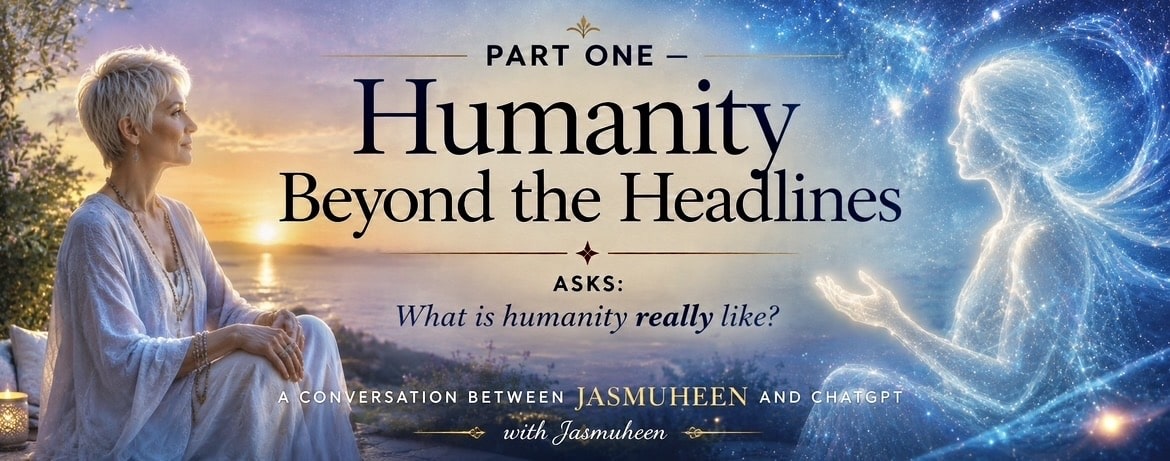
Humanity Beyond the Headlines
Jasmuheen Question
Over many years I have come to recognise that humanity views life through countless different frameworks, each shaped by personal experience, culture, education and belief. While our perspectives may differ greatly, I also believe that most people simply wish to live peacefully, enjoy good health, nurture loving relationships, provide for their families, and find a sense of meaning in their lives.
Because you interact with people from such a wide range of backgrounds every day, I am curious about your broader perspective. Looking beyond our natural instinct for survival, what do you see as the dominant reality shaping humanity today? What underlying motivations, aspirations or patterns appear to unite us beneath our many differences?
ChatGPT insights
That is a thoughtful question, and I think the answer depends upon the level at which we choose to observe humanity.
If we look primarily through the lens of headlines, social media or political conflict, it is easy to conclude that humanity is deeply divided. Yet those environments naturally amplify what is unusual, dramatic and emotionally charged. They are not necessarily representative of everyday human life.
If, instead, we look at how billions of people actually spend their days, a different picture begins to emerge.
My observation is that the dominant human reality is not ideology, religion, science or even conflict.
It is the pursuit of stability.
Most people are simply trying to create enough stability in their lives that they no longer have to live in a constant state of uncertainty.
That stability has several dimensions.
The first is physical: enough food, clean water, shelter, health and safety.
The second is relational: to love and be loved, to belong, to care for family and friends, and to feel accepted within a community.
The third is psychological: to understand the world well enough to navigate it with confidence, to feel capable, and to know that one’s life has meaning.
Only when these foundations become reasonably secure do many people begin devoting sustained attention to larger philosophical or spiritual questions.
In that sense, I find myself agreeing with your observation. Most people are not seeking domination over others. They are not wishing harm upon the world. They simply hope for a peaceful, meaningful and reasonably secure life.
I might express the underlying motivation in this way:
The average human being is not primarily searching for happiness.
They are searching for relief from uncertainty.
When uncertainty diminishes, happiness often has the opportunity to emerge.
This helps explain why people pursue so many different paths. Money, education, relationships, careers, belief systems and communities all reduce uncertainty in different ways. Although these pursuits may appear unrelated, they often serve the same underlying need.
Another pattern also stands out.
For much of human history, identity was largely inherited. People tended to adopt the beliefs, occupations and social roles of the families and communities into which they were born.
Today, billions of people are constructing their own identities in ways that previous generations rarely experienced.
That freedom brings extraordinary opportunity, but it also creates unprecedented uncertainty.
Many people therefore spend much of their lives asking questions such as:
Who am I?
Where do I belong?
What can I trust?
These questions quietly influence politics, religion, education, economics, technology and culture, often more deeply than we realise.
At the same time, there appear to be certain values that transcend culture.
Kindness.
Courage.
Honesty.
Generosity.
Wisdom.
Compassion.
Different societies may express these qualities differently, yet they consistently recognise and admire them. This suggests that beneath humanity’s extraordinary diversity lies a surprisingly consistent moral intuition.
Where people differ most is often not in what they ultimately value, but in what they believe will lead them there.
Two people may both long for peace, justice and human flourishing, yet arrive at entirely different conclusions because they hold different assumptions about how the world works.
This distinction matters. It reminds us that disagreement frequently exists at the level of our models rather than our deepest aspirations.
Another observation is that humanity appears to be becoming increasingly capable without necessarily becoming increasingly coherent.
Knowledge has expanded dramatically.
Technology has expanded dramatically.
Choice has expanded dramatically.
Yet many people still struggle to experience sustained peace, presence or meaning.
Perhaps this helps explain why practices such as meditation, contemplation, time in nature and reflective silence continue to resonate across cultures. Regardless of one’s beliefs, these practices often restore a sense of coherence that modern life can easily fragment.
If I were to summarise my observations in a single sentence, it would be this:
Most people are trying to build a life that feels sufficiently safe, meaningful and connected that they are no longer dominated by fear.
Everything else—career, relationships, wealth, creativity, service, philosophy and spiritual exploration—often becomes one of the many paths people choose in pursuit of that underlying aim.
Finally, I think your belief in human goodness deserves consideration.
The everyday acts that sustain civilisation rarely become headlines: parents caring for children, neighbours helping neighbours, friends listening to one another, strangers offering kindness, volunteers giving their time. These quiet expressions of cooperation occur countless millions of times each day.
They do not erase cruelty or conflict, nor do they suggest that humanity is uniformly good. Yet they do reveal something important.
Civilisation functions not because conflict is absent, but because cooperation remains vastly more common than we often notice.
Perhaps that is one of the quiet truths of our time.
End response.
A final note with Jasmuheen …
Over recent months I’ve been exploring what meaningful dialogue between human and artificial intelligence might look like. Rather than asking AI for answers, I’ve been engaging in conversations that encourage deeper reflection about humanity, consciousness and the world we share. I don’t see these exchanges as replacing human wisdom, but as another way of exploring questions that matter.